Text originally published in the brochure Paris Mystères (2017) and reproduced with the kind permission of the author.
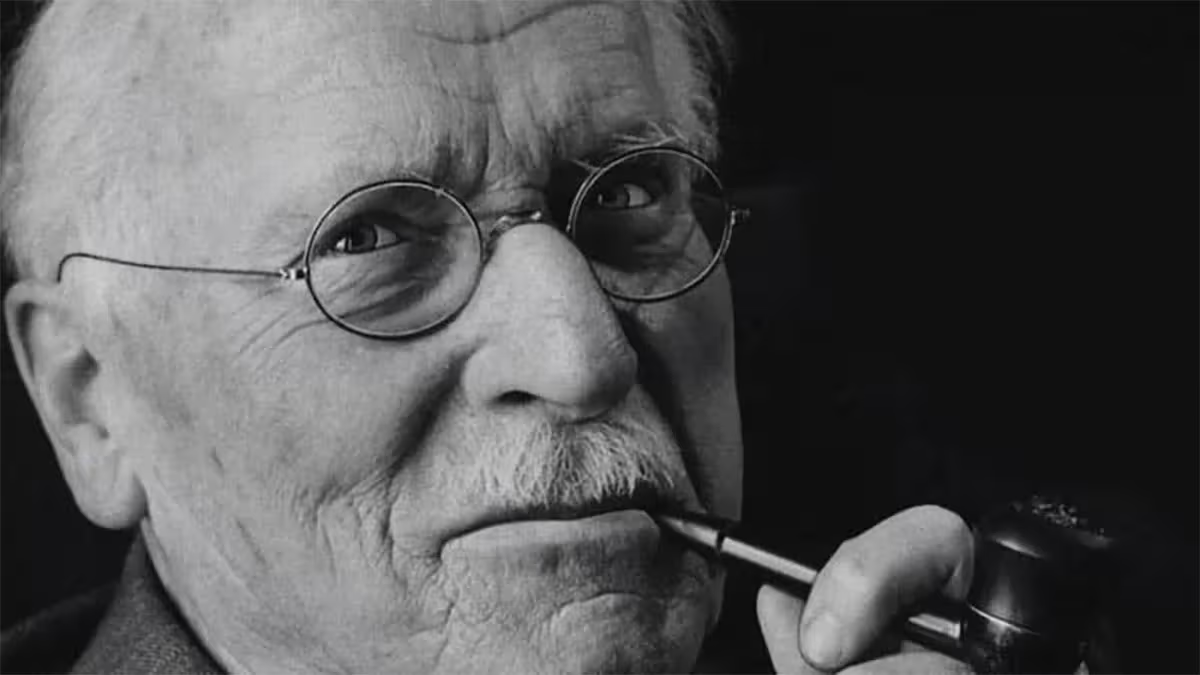
The word synchronicity was coined by psychologist Carl Gustav Jung to describe the simultaneous occurrence of two events connected not by cause, as is usually the case, but by the meaning they share.
Jung liked to illustrate synchronicity by telling the story of two scarabs. One day, as a patient was telling him about the other—a gold scarab jewel she had received as a gift in a dream the night before—an actual scarab suddenly struck Jung’s window. Had he not opened the window, caught the insect, and shown it to his patient while saying, “Here it is, your scarab!”, triggering a decisive breakthrough in her therapy, synchronicity might never have entered history.
Synchronicity can therefore be understood as the phenomenon that connects objects of study belonging to two different worlds: time and meaning, the universe of symbols.
Symplanicity
Graphic coincidences appearing on geographical maps in the form of straight lines carrying symbolic meaning.
The origins of this neologism
While investigating how a number of people perceived the phenomenon known as the Parisis Code, I initially used the word synchronicity to describe these coincidences—events linked not by cause, but by meaning.
I met quite a few so-called “experts” along the way, largely because synchronicity is the closest known phenomenon to what this geography of meaning reveals. I am grateful to Michel Cazenave, a leading interpreter of C.G. Jung, for pointing out that the term was not quite appropriate, since it is tied to time, and for suggesting that I find another one. Since the phenomenon itself was new, I found myself—like Jung after his scarab episode—having to invent a new word to describe it.
Etymological reference points
Sym: symbol, sympathy, symmetry, synthesis, attunement, simple.
These words all convey ideas of connection, resonance, harmony, meaning, as well as simplicity, intuition, synthesis, and a global view—as opposed to complexity, reason, analysis, and the local.
Planicity: because the link between the immaterial and the material does not take shape in time, nor in three-dimensional space, but specifically on a plane. And as a bonus, the phenomenon tends to reveal itself in cities or between cities.
A geometric reference
What is a straight line in geometry? It is the shortest path between two points, but also the line formed by the intersection of two planes. In the case of symplanicity, the plane of our material universe (three dimensions of space plus time), perceived through our five senses, filtered by the endocrine system, and conceptualized by the bio-computer we call the brain, intersects with the plane of Meaning—the symbolic universe.
Symplanicity and the symbolic world
Meaning appears through straight lines formed at the intersection of the phenomenal plane perceived by our physical senses and the metaphysical plane of Meaning.
To borrow a phrase from Luc Bigé: the archetype is the basic building block of the symbolic world, just as the atom is the basic building block of the material world. Neither is directly visible; both can only be detected through traces captured by appropriate tools.
Symplanicity is the phenomenon through which the universe of meaning can, under certain conditions, be perceived on geographical maps.
The Parisis Code revelation matrix, discovered in 2005 by Thierry Van de Leur from Strasbourg, is, to my knowledge, currently the most effective tool for bringing this phenomenon to light.
I personally discovered this phenomenon in 1989 while drawing lines across France.
It was only twenty years later that I became aware of the first volume of Parisis Code. I was both astonished and deeply impressed by the author’s painstaking, almost monastic work: he had uncovered thousands of lines of meaning across the capital. These discoveries have been published gradually over the years and now span some ten volumes.