
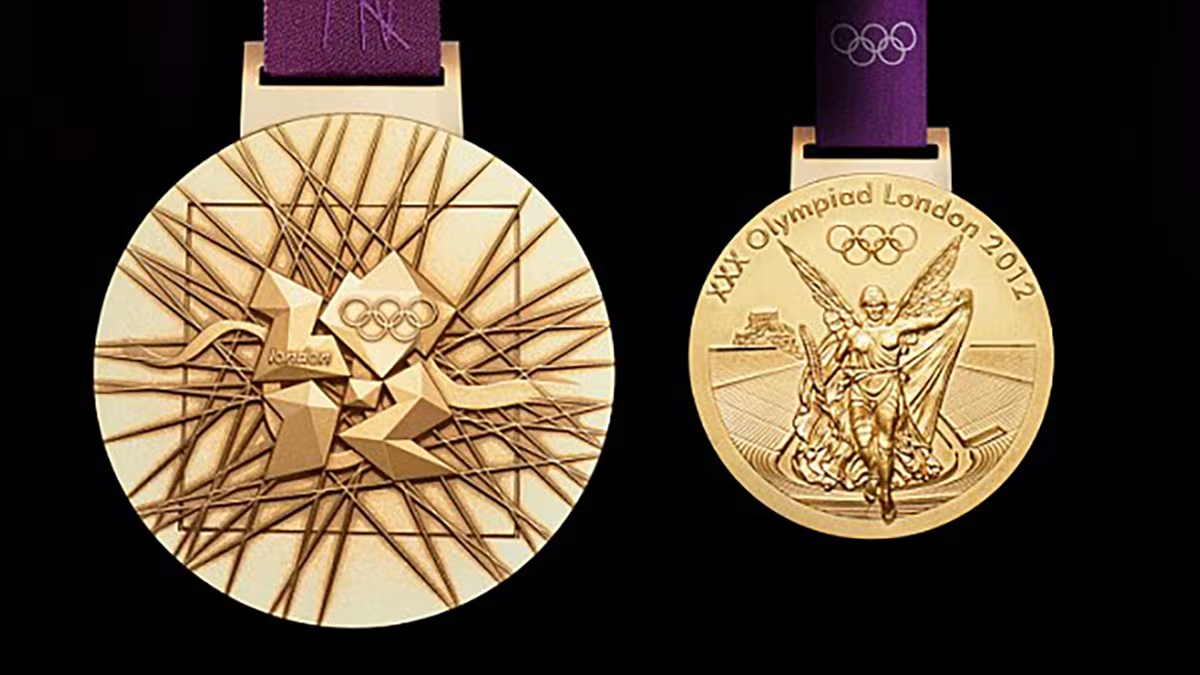
The logo, mascots and medals of the 2012 London Olympic Games were widely mocked when they were unveiled in 2007 and 2010, respectively. Their highly questionable aesthetic seems to run counter to all established design conventions.
From a marketing standpoint, provocation and boldness can nevertheless generate a viral effect. As the saying goes, “any publicity is good publicity.” From this perspective, Olympic branding achieved its intended goal.
However, a minor controversy broke out in the blogosphere in 2008 after a man named Rik Clay claimed to see, in the stylized “2012” of the logo, an anagram of the word ZiON. This young researcher also noted that many of the streets surrounding the Olympic site often carry biblical connotations. That was enough to spark a flood of speculation about the Olympic Games being used as an occult ceremony intended to found the “New Jerusalem,” a concept dear to ultra-Zionists (the Reichmanns, the Rothschilds, Christian conservatives, etc.).
This young researcher also noted that many of the streets surrounding the Olympic site often carry biblical connotations. That was enough to spark a flood of speculation about the Olympic Games being used as an occult ceremony intended to found the “New Jerusalem,” a concept dear to ultra-Zionists such as the Reichmanns, Rothschilds, and Christian conservatives.
This theory briefly surfaced in the mainstream media in early 2011 when Iran acknowledged its validity. Moreover, the apparent suicide of Rik Clay in August 2008 gave conspiracy theorists even more to chew on.
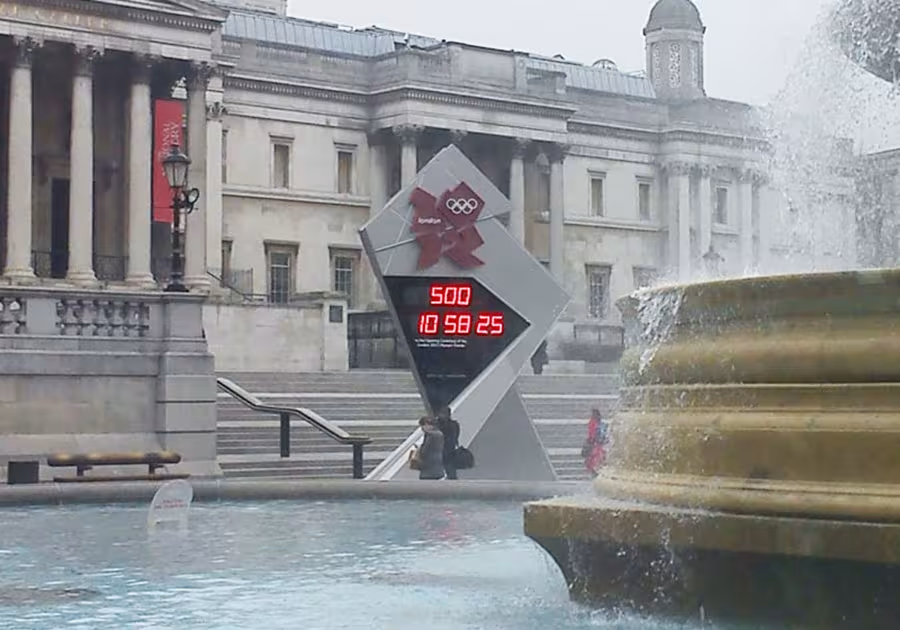
A Representation of Directed Energy Vectors?
Since the symbolism of the logo has already been widely analyzed online, this article will instead focus on the design of the medals and their possible meaning.
Rik Clay had noticed that many of the streets surrounding the Olympic site featured the prefix or suffix ley: Mabley Green, Adley Street, Leyton Road, and so on. Quite rightly, he connected this to the leylines theory popularized by Alfred Watkins in the early twentieth century.
Continuing along the same lines, it then becomes interesting to examine the official symbolism of the London 2012 medals, designed by a certain David Watkins (no proven family connection to Alfred Watkins). On July 27, 2011, The Guardian reported the following:
The core emblem is an architectural expression, a metaphor for the modern city, or a geological metaphor as a tough crystalline growth which is deliberately jewel-like. The grid of lines, meanwhile, brings both a pulling together and sense of outreach on the design – an image of radiating energy that represents the athletes’ achievements and effort. [...] But what light could he shed on the square that encloses the jagged 2012 logo? "It’s an almost metaphysical square," explained [Watkins] to a suddenly rather quiet room.
Thus, the medal’s designer refers to geology, crystals, and vectors of energy radiating from the Olympic Park. That symbolism feels very New Age, doesn’t it?
The following day, the cultural blog Londonist published an interesting article in which a medal was overlaid onto the Olympic site, using the River Thames as the spatial reference point (the stylized loop winding through the logo).
I freely recreated the diagram, this time trying to relate it to a previously created Google Earth map illustrating London’s main architectural alignments (available for download below). It should be noted that in this exercise, the exact position of the Thames was less important than the positioning of the vectors relative to one another.
Visualization in Google Earth
You are invited to download the attached .kmz file below in order to better visualize the alignments and points of interest it contains. (For best results, first disable the generic borders and place names provided by Google Earth, and enable the markers included in the file.)

The results are particularly interesting (refer to the small yellow dots in the slideshow to see what they represent). The Olympic Stadium is located at the apex of the triangle, while the word "London" corresponds to the cluster of skyscrapers that form the financial heart of Canary Wharf. The upper left corner of the "metaphysical square" corresponds to the intersection of two important leylines (Strand and Greenwich) in Victoria Park. The upper right corner of the square corresponds exactly to the Boleyn Ground, the stadium that is home to the West Ham football team. The venerable Tower of London (white dot) is located at the circumference of the medal.
It is more difficult to find such equivalents on the south bank of the Thames, although the outline of the square passes very precisely over the Royal Observatory Greenwich. In short, a number of highly symbolic and frequently visited locations are reflected in the geometry of the medals.
Megaliths Enter The Fray
But perhaps the most surprising thing is the proliferation of megaliths recently installed in the parks of the East End. These giant stones, inspired by Carnac or Stonehenge, neatly aligned or arranged in circles, are documented on the Ancient Hackney blog. It is astonishing that the landscaping of parks, gardens, and playgrounds has followed this approach for a decade, without any official development plan mentioning it.
Those familiar with the workings of acupuncture, acupressure, and reflexology already understand the concept of energy meridians—as well as their stimulation at specific points using needles.
By extension, could the stone circles of the East End designed to amplify the energy of the Olympic Park, or perhaps to channel certain energies toward it?
The Olympic Park is a place where thousands of athletes, spectators, and journalists will physically converge. It is designed to capture the psychic energy of hundreds of millions of television viewers. But to what end would this energy be amplified using ley lines? Where would it be redirected?
There are no clear answers to these questions.
However, if the branding of the 2012 Games aimed to celebrate the ancient origins of the British Isles, then we can say, "mission accomplished."